
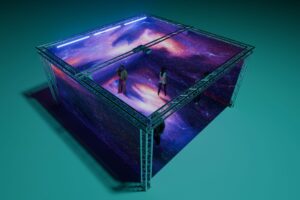
People expect more from events than a booth or a banner. Interactive exhibits, digital installations, and hands-on activations have become a bigger part of the event landscape, giving visitors something they can step into rather than simply observe.
Behind many of these experiences is a surprisingly simple structural element: the aluminum truss system.
While truss is often associated with stages, lighting rigs, and trade show displays, it’s also becoming a popular choice for building immersive environments. Its flexibility allows designers to create enclosed spaces that support projection mapping, LED displays, lighting, sound, and interactive technology without requiring permanent construction.
Creating a Blank Canvas for Digital Experiences
One of the biggest challenges in immersive design is creating a structure that can support technology while remaining visually unobtrusive.
Aluminum truss systems provide a framework that can be built around projection surfaces, fabric walls, LED panels, or printed graphics. Once the content is activated, the structure itself fades into the background, which allows visitors to focus entirely on the experience.
Whether the goal is to recreate a cityscape, an underwater environment, or a journey through space, the truss serves as the foundation that makes it possible.
Supporting Projection Mapping and Digital Content
With projection mapping, the room becomes part of the display. Content isn’t limited to a monitor or video wall, it can appear across the surfaces that make up the environment itself, changing the way visitors experience the space.
Aluminum truss systems make this easier by providing stable support for:
- Projection surfaces
- LED panels
- Projectors
- Lighting fixtures
- Audio equipment
Because everything can be mounted to a single structure, the environment remains organized while keeping technology out of the visitor’s direct view.
Flexible Layouts for Creative Concepts
No two immersive projects are exactly alike, and the space often needs to adapt to the experience being created. Some installations call for an enclosed environment, while others work better with a more open design that allows visitors to enter and interact from different angles.
One of the advantages of aluminum truss is that it doesn’t lock a project into a single layout. If the design changes, sections can be added, moved, or reconfigured without rebuilding the entire structure. That gives designers more freedom to experiment and make adjustments along the way.
That flexibility is especially valuable for touring exhibits, traveling activations, and temporary event installations.
Ideal for Trade Shows and Brand Activations
Trade shows can be challenging environments for brands trying to stand out. Attendees are surrounded by booths, signage, and competing messages.
Immersive spaces offer a different approach. Instead of asking visitors to look at a display, they invite them to step inside an experience.
Aluminum truss systems make these environments possible by providing the framework for enclosed rooms, interactive displays, projection surfaces, and branded content. The result is often a more memorable experience and longer visitor engagement.
Built for Temporary Installations
Many immersive experiences are designed to be temporary. They may only be in place for a few days, a few weeks, or a single event.
Because aluminum truss systems are modular, they can be assembled, dismantled, and transported without extensive construction. Components can be reused for future installations, making them a practical option for agencies, event producers, and exhibit designers who need flexibility from project to project.
Supporting More Than Just Visuals
Immersive environments often combine multiple technologies to create a complete experience. Lighting, sound, video, sensors, and interactive elements all need a place within the design.
Aluminum truss systems provide mounting points for equipment while helping keep cabling organized and out of sight. This allows the technology to support the experience without becoming the focus of it.
Why Designers Continue to Choose Aluminum Truss
The visuals may be what capture attention, but there’s a lot happening behind the scenes to make an immersive experience work. Every projection surface, display, lighting element, and piece of technology needs a structure that supports it all.
It allows designers to build temporary environments that feel permanent, support technology without overwhelming the space, and adapt to different venues as projects evolve.
As immersive experiences continue to grow in popularity, aluminum truss systems are becoming an important part of how those environments are brought to life.
Final Thoughts
When people think about immersive experiences, they usually focus on the visuals, the storytelling, or the technology. What often goes unnoticed is the structure supporting everything behind the scenes.
From projection-mapped rooms and digital art exhibits to interactive brand activations and fan experiences, aluminum truss systems provide the framework that helps turn creative concepts into fully realized environments.
The best immersive spaces make visitors forget about the structure entirely—and that’s often a sign the truss system is doing exactly what it was designed to do.